Coalition: SC historic places under in jeopardy under federal ‘reform’ bill
CONTACT: Sam Spence, Preservation Society of Charleston ([email protected])
South Carolina history and cultural nonprofits are sounding the alarm that historic places will be threatened under a proposed reform bill that could come up for a vote in the U.S. Senate on Nov. 9.
The Preservation Society of Charleston has led the organization of 20 cultural history organizations to call on South Carolina’s governor and U.S. senators to carefully consider the ramifications of reforms to the Section 106 process inside the landmark National Historic Preservation Act of 1966 (NHPA) that allow citizens and tribal leaders to take an active role and advocate for historic places in their communities.
Groups statewide signed on to letters sent to Gov. Henry McMaster as well as U.S. Sens. Tim Scott and Darline Graham over the summer, raising the issue of unintended impacts tucked into a sweeping reform bill (S.5653) primarily aimed at facilitating energy projects.
“The Bipartisan American Affordability and Jobs Act, while well-meaning in name, contains the most significant change to federal preservation law in 60 years,” Preservation Society President and CEO Brian Turner wrote in an op-ed published Monday in the S.C. Daily Gazette.
WHAT IS SECTION 106? Under Section 106 of the NHPA, projects that use federal resources are required to engage with parties potentially impacted. The projects can range from large infrastructure to federal courthouses. The proposed reform law would make those local consultations optional, removing the chance for local communities, organizations, and tribal members to have a say in projects that will affect them.
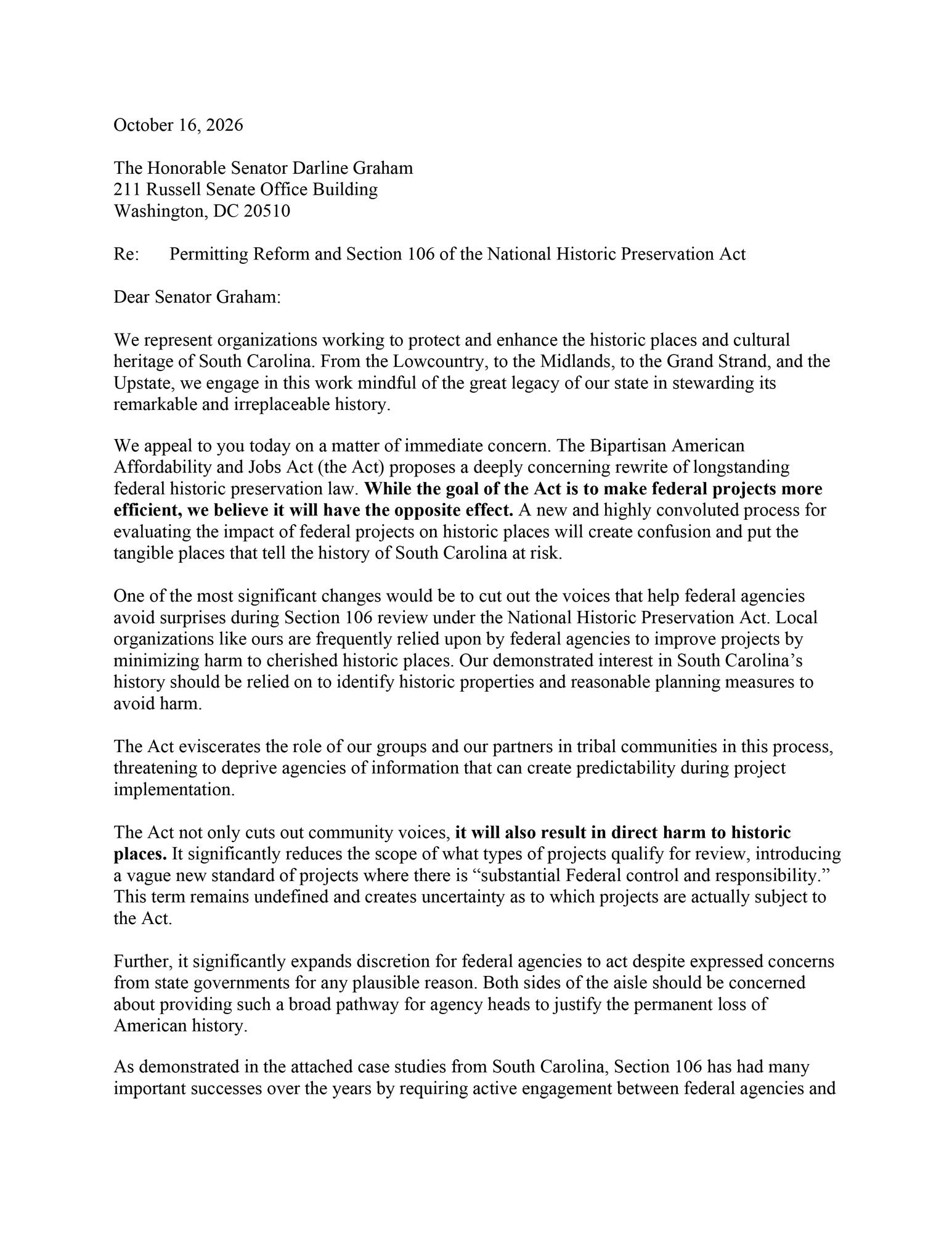
Writing to U.S. senators in an Oct. 16 letter (included below), the coalition of cultural organizations were direct in their assessment:
“The Act eviscerates the role of our groups and our partners in tribal communities in this process, threatening to deprive agencies of information that can create predictability during project implementation.
The Act not only cuts out community voices, it will also result in direct harm to historic places.”
(NOTE: The coalition previously sent the governor’s office a similar letter on Aug. 21, 2026, about a regulatory change proposed over the summer that largely mirrors provisions in the latest Senate bill.)
There are many examples of Section 106 success stories across South Carolina:
- J. Waties Waring Judicial Center (Charleston): A new federal courthouse complex was redesigned to be sensitive to the nearby Charleston Historic District.
- Florence National Cemetery: The Department of Veterans Affairs responded to concerns about the expansion of a national cemetery by documenting a known nearby Civil War-era Confederate prisoner camp and minimizing local impacts.
- H.L. Hunley Confederate submarine (Charleston): The 1995 discovery of the Confederate submarine set off a Section 106 process that resulted in a detailed agreement that detailed a wide-ranging conservation and documentation project.
- Fish Dam Ford Revolutionary War battlefield (Chester County): A bridge replacement project that included Section 106 consultation with local and tribal organizations resulted in the perpetual conservation of a nearby Revolution-era battlefield at Fish Dam Ford.
DETAILS: The Bipartisan American Affordability and Jobs Act is scheduled for a vote as part of a larger funding bill before the U.S. Senate in the lame-duck session on Nov. 9, 2026. There are still opportunities for changes to the language until passage.
ANALYSIS: The bill is co-sponsored by Democratic and Republican committee leaders in the Senate, but those committees have not publicly vetted its language. A Senate vote Nov. 9 will determine whether it has enough support to move forward unaltered, or whether there will be amendments before it is sent to the U.S. House. While Congressional leaders hope to have the bill passed during the lame-duck session before the new Congress is sworn in on Jan. 3, 2027, an amendment process could take time. Advocates for historic preservation are urging that the changes to Section 106 (54 U.S. Code Section 306108) be removed from the bill.
[VIEW THE FULL LETTER IN PDF FORM]